
The Yesil, also known as the Esil or Ishim, drains a snowmelt-dominated basin in northern Kazakhstan. The spring freshet arrives fast and concentrated, because the soil column is still frozen when melt begins. In March and April 2024 the basin produced Kazakhstan’s worst flooding in around eighty years, overtopping reservoirs downstream and forcing evacuations at Petropavlovsk. Those events are the reference against which the new scheme’s contribution to flood risk reduction is assessed.
The Yesil Integrated River Basin and Infrastructure Solutions Project responds with a 23 metre compacted earthfill counter-regulator upstream of Kurskoye, re-regulating a river that is already impounded further upstream. Outside the flood season the structure is held as a dry detention basin, so that storage is available at the onset of melt to intercept and re-time the freshet before it reaches the downstream reservoir cascade. The design life is 30 years. The Asian Development Bank classifies the scheme as directly exposed to climate risk, which calls for climate due diligence before investment.
FutureWater carries out the climate risk and adaptation assessment. The assessment establishes the observed climate of the basin from the ERA5-Land reanalysis and the projected climate from a CMIP6 ensemble under a moderate and a high emissions pathway, and traces what both imply for snowpack, melt timing and flood magnitude at the dam axis.
Its scope covers the design flood and the flood-frequency basis on which the structure is sized, the reservoir routing and freeboard, the operating rules for detention and release, and the monitoring needed to manage what remains uncertain. Adaptation measures are identified for each material risk and framed so that they can be carried into the design, the operating plans and the project’s dam safety case.
FutureWater also prepares the climate change assessment supporting the project’s alignment with the Paris Agreement and its climate finance categorisation, and provides climate risk and adaptation inputs to the Asian Development Bank’s project documentation.
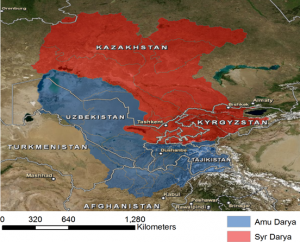 The objective of this study is to support the “Central Asia Regional Energy Sector Vulnerability Study” led by Industrial Economics (IEc) and funded by the World Bank, by carrying out an expanded risk assessment for water availability and water related energy sector impacts in the region. The work will build on the existing tools developed
